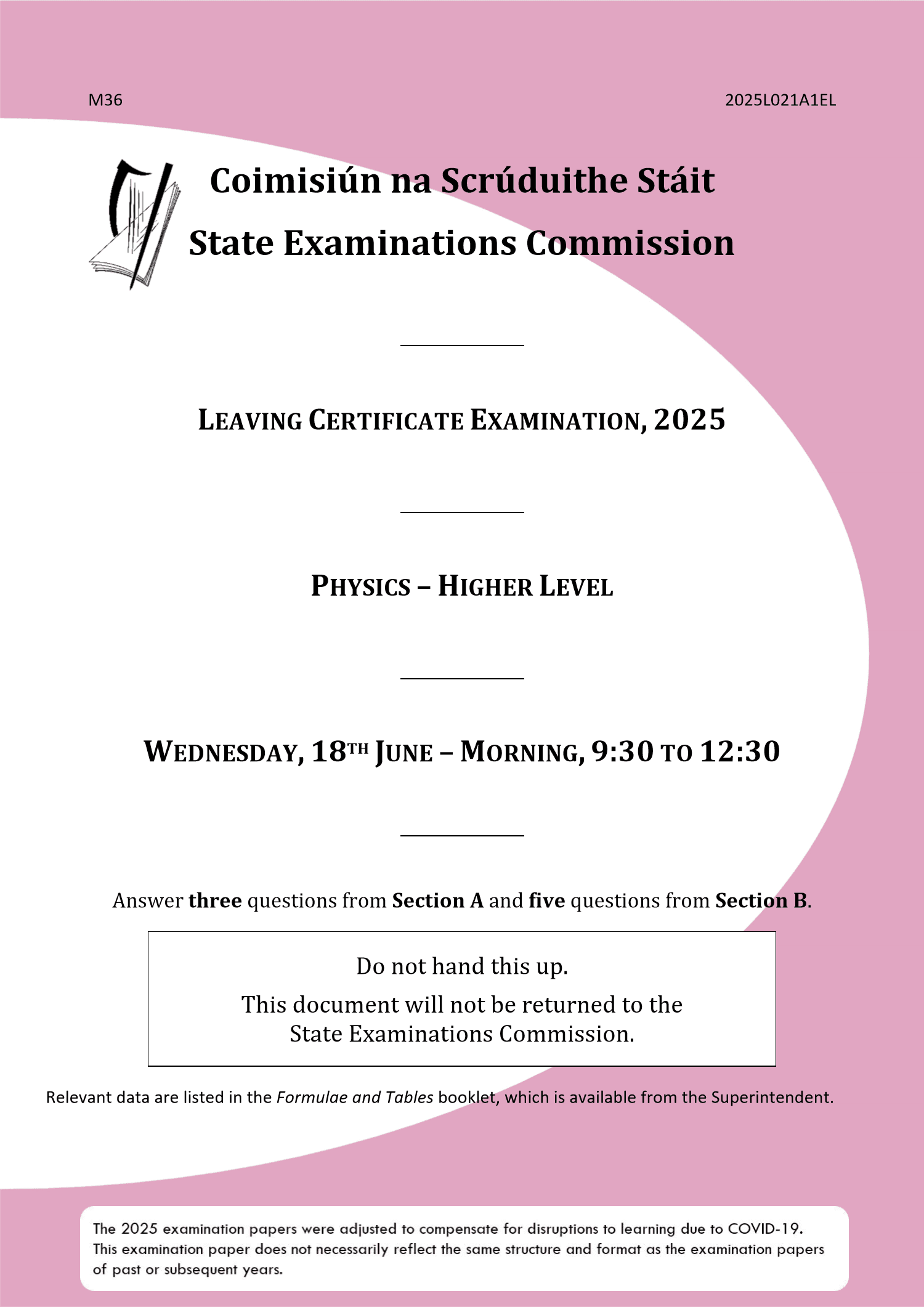
Previous syllabus (up to June 2026)
The previous syllabus was last examined in June 2026 through a terminal written examination. It should be distinguished from the specification introduced to fifth-year students in September 2025.
Leaving Certificate Physics explores how the physical world works, from motion and energy to waves, electricity and modern physics. Students use models, equations, experiments and evidence to explain natural phenomena and technological applications.
The subject combines conceptual understanding, practical investigation and mathematical problem-solving. Students learn to reason carefully, use data well and communicate physical ideas clearly.
Explore the course, compare lesson packages or ask us about your year, level and study goals.
The previous syllabus was last examined in June 2026 through a terminal written examination. It should be distinguished from the specification introduced to fifth-year students in September 2025.
For students who began fifth year in September 2025, the new specification is first examined in 2027. The additional assessment component is worth 40% and the written examination is worth 60%.
For the specification in effect for 2027 examination cohorts onward, the official course is organised as follows:
For students who began fifth year in September 2025, the new specification is first examined in 2027. The additional assessment component is worth 40% and the written examination is worth 60%.
Curriculum sources checked:
Zr Academy offers Physics grinds in Dublin 2 and online for students who want stronger calculations, cleaner experiments and more reliable problem-solving.
We use necessary cookies and local storage for secure sign-in, language and notice preferences. See our Privacy Policy for details.